What a dog house heater costs to run
A dog house heater runs on a thermostat, so its real bill sits well below the worst case. Working out that worst case takes one line of arithmetic, and it tells you which type of heat is cheap to leave on all winter.
The one formula you need
Your electricity bill counts kilowatt-hours. To find them, multiply the heater’s watts by the hours it runs, then divide by 1,000, and multiply the result by the rate on your bill.
A 400 W heater running for 24 hours straight uses 9.6 kWh. A 60 W heated pad over the same day uses 1.44 kWh, less than a sixth of that.
Every cost on this page uses an example rate of 15 cents per kWh. Rates differ a lot between states and utilities, so swap in the figure from your own bill to get your number.
The worst case for each of the six
The chart shows the most each heater could use if it ran flat out for a whole day. No thermostat-controlled heater should do that in a sealed, insulated house, so read these as ceilings.
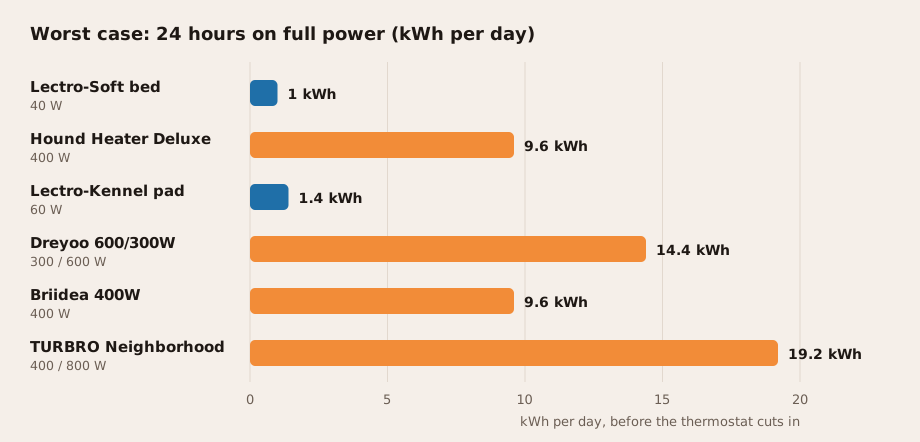
| Heater | Full power | kWh in 24 hours | Example cost per day at 15 cents |
|---|---|---|---|
| Akoma Hound Heater Deluxe | 400 W | 9.6 | about 1.44 dollars |
| K&H Lectro-Kennel (Medium) | 60 W | 1.44 | about 22 cents |
| Dreyoo 600/300W | 600 W (300 W mode) | 14.4 (7.2) | about 2.16 dollars (1.08) |
| Briidea 400W | 400 W | 9.6 | about 1.44 dollars |
| TURBRO Neighborhood | 800 W (400 W low) | 19.2 (9.6) | about 2.88 dollars (1.44) |
| K&H Lectro-Soft (Medium) | 40 W | 0.96 | about 14 cents |
Watts come from the listings and maker data. The Lectro-Kennel’s 60 W is K&H data quoted by retailers, as the Amazon listing does not state it.
Why your bill comes in lower
Every wall heater in the lineup has a thermostat. Once the air in the house reaches its set point, the element stops, and it starts again only when the house cools.
The share of the day a heater actually runs depends on the cold outside, the size of the house and how well it holds heat. As an illustration, a 400 W heater that runs half the time uses 4.8 kWh, about 72 cents a day at the example rate.
The heated pads go further. The Lectro-Kennel and Lectro-Soft warm up only while the dog lies on them, so an empty pad draws little, and their full-day ceiling is already small.
- Hound Heater
- Thermostat knob; medium is about 45–50 °F, per one retailer
- Dreyoo
- Fixed thermostat, starts under 68 °F and shuts off over 78.8 °F
- Briidea
- Adjustable 32–122 °F; the fan runs 5 more minutes after the set point
- TURBRO
- Set temperature and timers in the AIR.ai app
A thermostat you can set low saves the most. The Dreyoo’s fixed range aims at a warm room, so in a leaky house it may run far longer than a heater held at 45 °F.
A month of heat at the example rate
Thirty nights of a 400 W heater running nonstop would use 288 kWh, roughly 43 dollars at 15 cents. If the thermostat keeps it on half the time, that drops to about 22 dollars.
A 60 W pad running nonstop for the same month uses about 43 kWh, close to six and a half dollars. A 40 W soft bed comes in under five dollars, even if the dog never gets off it.
The gap explains why a pad is the frugal choice for a dog that sleeps curled in one spot. Our guide on choosing a heater or a heated pad covers when warm air is still the better pick.
Pick the right size first
More watts do not mean a warmer dog if the house is small and sealed. A typical house of 36 × 30 × 30 in holds about 19 cubic feet, while the wall heaters in this lineup are rated for 100–150 cubic feet, with plenty of margin.
That margin is why the low setting is often enough. Our guide to how many watts a dog house needs does the sums for your own house.
The TURBRO Neighborhood tops out at 800 W, the highest ceiling here, yet its app lets you set temperatures and timers from your phone. The TURBRO review covers its more mixed owner feedback.
Five habits that cut the bill
- Insulate the walls, roof and floor before you add heat
- Hang a door flap so warm air stays inside
- Set an adjustable thermostat as low as keeps the dog comfortable
- Use the low power mode on dual-wattage heaters
- Unplug the heater on mild days and through spring
Insulation does the most work by far. Our guide on how to insulate a dog house first shows how a well-sealed house lets a thermostat switch off for long stretches.
Cheap power is no use if the cord is unsafe. Our guide to GFCI outlets and outdoor cords explains how to bring power to the house without a chewed or soaked cable.
Cheap to buy or cheap to run
The cheapest heater to buy is not always the cheapest to run. The budget Dreyoo has a 600 W mode, while the pricier pads draw a tenth of that.
Our guide to budget dog house heaters weighs the purchase price against upkeep. The comparison table puts the watts of all six side by side.
For a full look at each model, our dog house heater comparison ranks the six. The best heated pad is the lowest-cost way to warm a dog that sleeps in one spot.
If low running costs matter most
The K&H Lectro-Kennel draws 60 W in the Medium size and warms only while the dog lies on it, so even a full winter day costs little. It does not warm the air, so a drafty house still needs insulation and a door flap.