Wall heater or heated pad for your dog house
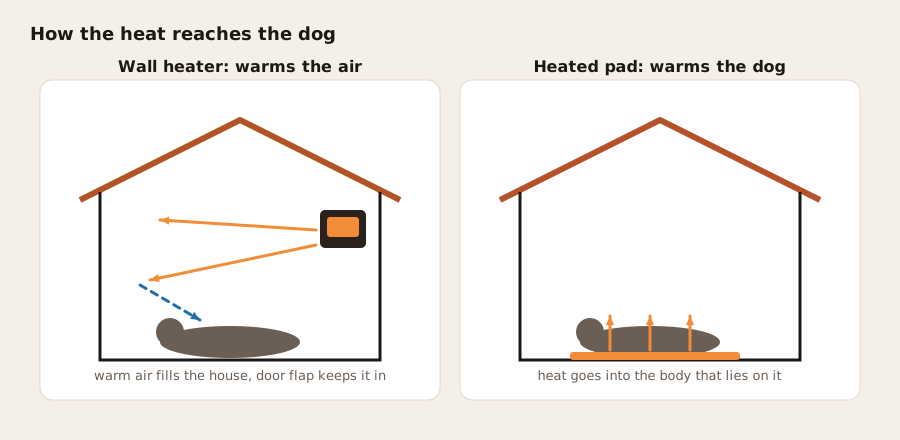
A wall heater warms the air inside the dog house, and a heated pad warms the dog that lies on it. Both make an outdoor dog more comfortable, but they suit different dogs and different winters, so this guide helps you pick one or decide you need both.
Two ways to deliver heat
A wall heater such as the Akoma Hound Heater has a fan and an element that blow warm air into the house. The whole space warms up, including the air your dog breathes and the spot by the door.
A heated pad sits on the floor and warms its own surface. The heat goes into the body resting on it, which is why a pad gets by on a fraction of the power.
How a wall heater works for a dog
The heaters in our lineup draw 300 to 800 W and run off a thermostat. The Hound Heater’s knob sits on top, and a retailer puts its medium setting at about 45 to 50 °F, enough to take the bite out of a freezing night.
Warm air helps a dog that moves around inside the house, or one with a thin coat that loses heat all over. Akoma also describes the Hound Heater as giving dry heat, which helps against damp bedding.
The downsides are installation and power. A wall heater has to be mounted high and wired with care, and our guide on installing a dog house heater walks through every step.
How a heated pad works for a dog
The K&H Lectro-Kennel is a rigid plastic pad with a steel-wrapped cord and a fleece cover. The Medium measures 16.5 × 22.5 in and uses 60 W, per K&H data quoted by retailers.
Its thermostat warms the surface to about 100 °F when a dog lies on it. The listing warns it may feel cool to your hand otherwise, which is normal and not a fault.
A pad goes in with no tools. You lay it down, run the cord out of the house through a chew guard and plug it in, and the dog decides when to use it.
Its limits are coverage and chewing. A pad does nothing for the air, and a soft pad is risky with a dog that chews, which is why K&H says its soft Lectro-Soft bed is not for chewers.
Side by side
| Wall heater | Heated pad | |
|---|---|---|
| Heats | The air in the house | The dog lying on it |
| Power in our lineup | 300 to 800 W | 40 to 60 W |
| Energy if run nonstop | 9.6 kWh a day at 400 W | 1.44 kWh a day at 60 W |
| Install | Mounted high on a wall, cord out the back | Laid on the floor, cord out the back |
| Chewing risk | Cord only, the heater sits out of reach | Cord and pad; rigid pads resist better |
| Suits | Thin coats and harder cold | Dogs that curl up to sleep, milder cold |
All six products are dog house heaters compared on one page. The homepage section on how the heat reaches your dog gives the same split in one picture.
What each one costs to run
Energy follows watts. With power at an example 15 cents per kWh, a nonstop 400 W heater would cost roughly 1.4 dollars a day, while a 60 W pad running nonstop comes to about 22 cents.
Neither runs nonstop in practice, because both have a thermostat. A pad still wins by a wide margin, and that gap grows over a long winter of cold nights.
Which one for your dog
- Short coat, small, old or recovering dog: a wall heater, because the whole body loses heat and warm air reaches all of it
- Healthy dog with a thick coat that mostly sleeps in the house: a heated pad is often enough
- Large or shared house: a wall heater, since one pad can’t warm two dogs at once
- Dog that chews everything: a wall heater mounted out of reach, or a rigid pad like the Lectro-Kennel, never a soft heated bed
- No outlet near the house: neither, and our guide to keeping a dog house warm without electricity lists the alternatives
Cold, climate and combining the two
In milder winters, with nights near or a little below freezing, a pad and a well-built house cover most healthy dogs. As temperatures drop further, warm air starts to matter more, because the dog has to leave the pad to eat and drink.
Some owners use both, a heater on low for the air and a pad for the floor. If you do, keep the pad on part of the floor only and mount the heater well away from the bedding.
Whatever you choose, sizing still applies. Our guide on how many watts a dog house heater needs explains why 400 W is enough for nearly every single-dog house.
Safety differs, too
A wall heater’s risk sits in its height and its cord. A pad’s risk sits on the floor, where the dog can chew the cord or the pad, and where it must never cover the whole floor.
Both need a GFCI outdoor outlet and a cord the dog can’t reach. The full list sits in our dog house heater safety rules, and none of it changes with the kind of heat you pick.
Still torn? Our head-to-head of the Hound Heater and the Lectro-Kennel sets warm air against a warm floor, product by product, for dogs that need more than our top pick gives.
A warm floor without tools
The K&H Lectro-Kennel is a rigid 60 W pad that warms to about 100 °F under the dog, with a steel-wrapped cord that resists chewing. It does not heat the air, so in hard cold or for a thin-coated dog, add a wall heater or bring the dog in.
Its card on the homepage, our best heated pad, sums it up in one view.
