How many watts does a dog house heater need?
Most dog house heaters are rated for far more space than a dog house holds, so the wattage is rarely the problem. This guide shows you how to measure your house, how the six products compare by power, and when more watts help or only cost you more.
Why watts matter less than you think
A dog house is tiny next to any room you heat for yourself. The wall heaters in our lineup are rated for 100 to 150 cubic feet, while a typical house for a medium dog holds about a fifth of that.
So the real question is rarely raw power. It is whether the house holds the heat and whether a thermostat stops the heater from running all day, which our guide on insulating the dog house before you add heat covers in detail.
Measure the house in cubic feet
Makers rate dog house heaters by the air they can warm, so start with the inside of the house. Multiply the three inside measurements in inches, then divide by 1,728 to get cubic feet.
- Small house for a terrier-sized dog, 24 × 30 × 24 in: 17,280 ÷ 1,728 = 10 cubic feet
- Medium house, 36 × 30 × 30 in: about 19 cubic feet
- Large house for a big breed, 48 × 36 × 36 in: about 36 cubic feet
- Shared house for two dogs, 60 × 48 × 48 in: about 80 cubic feet
Even the large house sits well inside the 100 cubic feet Akoma gives the Hound Heater. That is why a 400 W heater is plenty for almost any single-dog house, and an 800 W setting is rarely needed.
Measure the inside, not the outside, and leave out a covered porch or an entry tunnel. Thick walls and a raised floor can shrink the heated space by a surprising amount.
The six by rated power
Power on the highest setting runs from 40 W for a soft heated bed up to 800 W for the TURBRO on high. The chart puts them side by side, and the table adds what each maker says the product can warm.
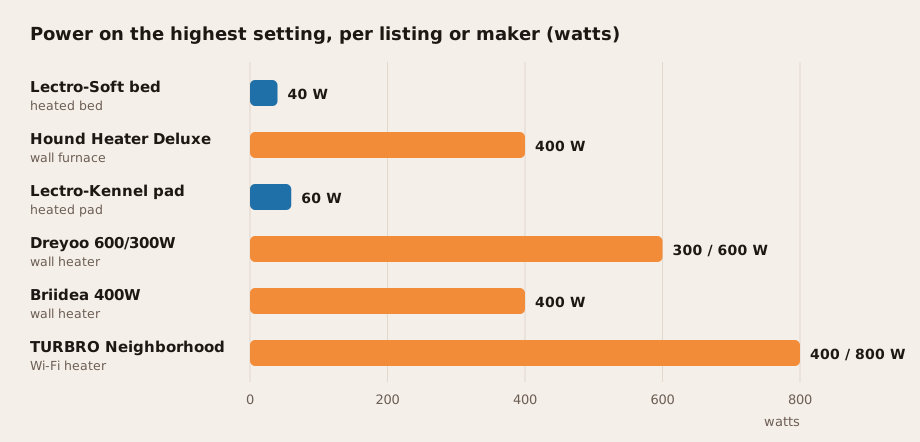
| Product | Type | Power | Rated space | Thermostat |
|---|---|---|---|---|
| Akoma Hound Heater Deluxe | Wall furnace with fan | 400 W | Up to 100 cubic feet (Akoma) | Adjustable knob on top |
| Briidea 400W | Wall fan heater | 400 W | Up to 120 cubic feet (listing title) | Adjustable, 32–122 °F |
| TURBRO Neighborhood WiFi | Wall fan heater | 400 W low, 800 W high | Up to 150 cubic feet (listing) | Set in the app |
| Dreyoo 600/300W | Wall fan heater | 300 W or 600 W | Up to 105 sq ft (listing) | Fixed, heats below 68 °F |
| K&H Lectro-Kennel (M) | Rigid heated pad | 60 W | The dog lying on it | About 100 °F in use |
| K&H Lectro-Soft (M) | Soft heated bed | 40 W | The dog lying on it | Toward body temperature in use |
The Dreyoo is the odd one out, because its listing quotes square feet “depending on whether your room is airtight” rather than cubic feet. Read that as a rough sign of strength, not a sizing promise.
The full spec rows sit in the comparison table on the homepage. If you want our verdict rather than the raw numbers, the best dog house heater shortlist explains why our top pick is a 40 W heated bed, and when a wall heater is the better buy.
When more power makes sense
A bigger setting helps when the house leaks heat faster than a small heater can replace it. That happens with a thin uninsulated shell, or with a doorway that has no flap and faces the wind.
It also helps in hard cold. Our guide on how cold is too cold for an outdoor dog sets out where the risk rises, and below about 20 °F every dog outdoors faces hypothermia and frostbite, heater or not.
Before you buy watts, fix the leaks. A door flap and some insulation often do more than doubling the heater, and they cost nothing to run.
Why oversizing costs you
A heater with a thermostat cycles off once the air is warm, so a strong unit in a small house wastes less than you might fear. The trouble starts with a fixed thermostat set well above what the dog needs, or a dial turned all the way up.
Watts translate straight into electricity. Energy in kWh is watts times hours divided by 1,000, so 400 W running nonstop for a day uses 9.6 kWh and 800 W uses 19.2 kWh.
At an example rate of 15 cents per kWh, that is roughly 1.4 dollars a day for the 400 W heater and about 2.9 dollars for 800 W, before any thermostat cuts in. Our running cost guide works through realistic figures.
A pad needs no sizing at all
A heated pad heats the dog, not the air, so house volume barely matters. The Lectro-Kennel Medium uses 60 W and warms its surface to about 100 °F once a dog settles on it, per K&H data quoted by retailers.
Run nonstop, 60 W comes to 1.44 kWh a day, a fraction of any wall heater. Whether warm air or a warm floor suits your dog is the subject of our guide to choosing a wall heater or a heated pad.
For a pad, size means floor area instead. Pick one that covers only part of the floor, so your dog can move off it when it gets too warm.
Sizing in four lines
- Single dog, ordinary house: a 400 W heater rated for 100 cubic feet or more is ample
- Drafty or uninsulated house: insulate and add a door flap first, then consider an adjustable 400 W unit
- Large or shared house: a dual-setting heater such as the TURBRO, run on low most of the time
- Dog that only needs a warm spot to sleep: a 60 W heated pad instead of a wall heater
The homepage buying guide adds thermostat and cord length to the sizing question. Both matter more in daily use than an extra 200 W.
Enough heat for almost any dog house
Akoma gives the Hound Heater Deluxe 400 W and a rating of up to 100 cubic feet, and fits it with a thermostat knob and a heavy-duty chew-proof cord. It is the priciest heater here, and our Hound Heater review weighs that against the cheaper rivals.
